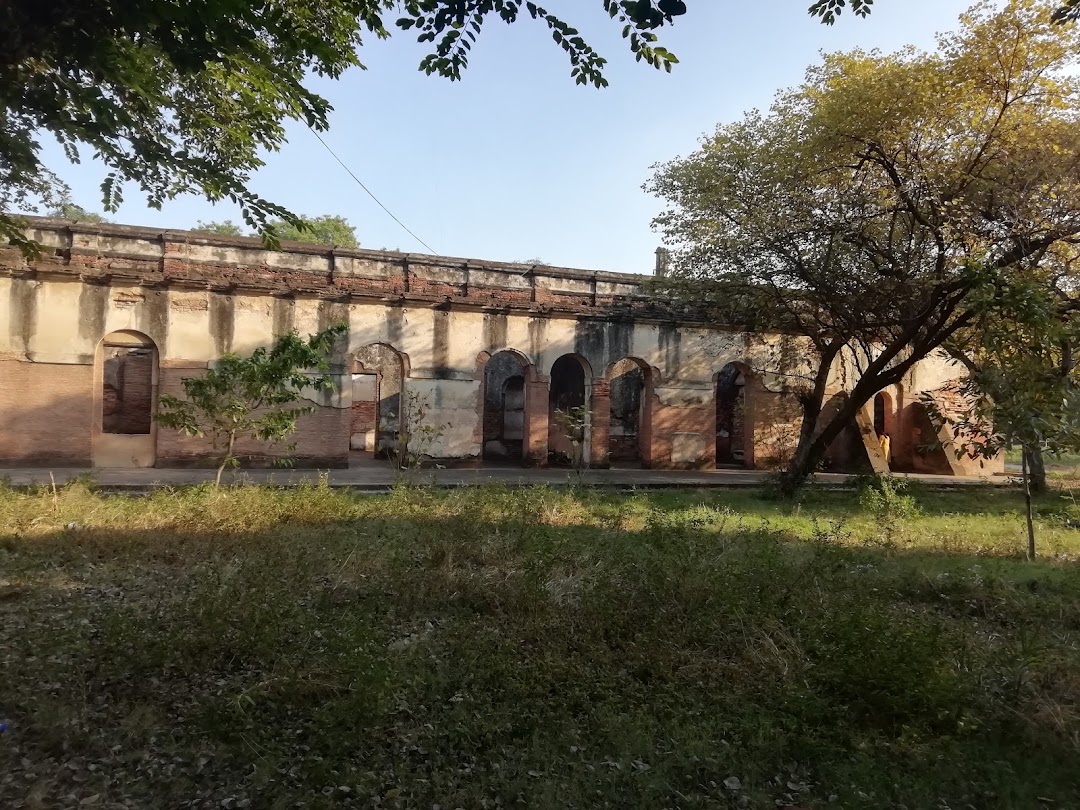
The Begum Kothi (Ladys Quarters) was a large, imposing building with a lofty gateway and a double range of outer buildings which formed a square within a square, one side of which was the Imambara. An upper room of the Begum Kothi served as the Commissariat store-room, while the house of Mr. Quieros (today labelled the Kitchen) with its adjoining stables was utilised as a canteen and as a liquor store room. As the house and the main guard house behind it, was connected to the Begum Kothi by a passageway they were considered a part of the complex.
It originally belonged to Nawab Asaf-ud-daula and subsequently was sold to some Europeans who ran a business in europion goods. Later on, it was occupied by Vilayalti mahal Makhdarah Aliya, the begum of Nasir-ud-din-Haider. After her death her step-sister Sharfunnisa and built an Imambara and a mosque at this place in a traditional architectural style of Avadh unlike other buildings of the residency, remains of which are available. 1857-Memorial Museum Residency and other old structure is near this place.
It was constructed for an English wife of the nawab who lived in the residency. A mosque is attached to this.
The Begum Kothi (Ladys Quarters) was a large, imposing building with a lofty gateway and a double range of outer buildings which formed a square within a square, one side of which was the Imambara. An upper room of the Begum Kothi served as the Commissariat store-room, while the house of Mr. Quieros (today labelled the Kitchen) with its adjoining stables was utilised as a canteen and as a liquor store room. As the house and the main guard house behind it, was connected to the Begum Kothi by a passageway they were considered a part of the complex.From its position and from the mass of its masonry, the Begum Kothi was one of the safest places to be. In spite of this, Mrs. Bartrum, who spent the entire siege in this building, was less than thrilled.She describes the Begum Kothi as being both uninviting and dirty, with no punkahs to fend off the heat and the flies, and without any furniture. Initially she shared one room with 15 other women and their children, sleeping on the floor on mats though later they did get some charpoys to sleep on, three chairs and a table.Mrs. Bartrum was a fugitive from Gondah (along with Mrs. Clarke and Mrs. Hale, who shared her room at the Begum Kothi) and had arrived at the Residency with nothing but the clothes on her back and her infant son – her husband, Robert, had remained behind in Gondah. As a lady without any particular rank and lacking influential friends in the Residency Mrs Bartrum was one of the many women left to fend for themselves. Her food did not come out of private stores, she drew her rations from the commissariat stores and when the last servants fled the chaos of the siege, she took it upon herself to keep the room clean -some of the other women were mentally and physically too ill to care. Determined as she was to “add to the comfort of others” she adds rather sardonically, “even if I afford them amusement by giving them occasion to call me servant-of all -work.” For a time, while she was still strong, her child healthy and she was receiving occasional news from her husband, Mrs. Bartum was able to take on the work in a grim but certainly determined fashion. But as the months wore on, her own health started giving way and her son suffered repeatedly from dysentery, she writes, “...I am not inclined to look on the bright side of anything now, all looks so dark and there is no sweet hope…” With few influential friends, Mrs. Bartrum had to rely on the help of strangers – a soldier who cut some firewood for her when her own dinner knife proved to be too blunt, a little milk for her child which she received every day from Mrs. Ousely, and the kind Dr. Darby who did what he could for the young widow, bringing arrowroot and suji to supplement her infant’s diet and lancing the boils that erupted on Mrs. Bartrums’ fingers. It was the kindness of a fellow sufferer – he had left his wife and baby behind at Kanpur.Mrs. Bartrum did all her cooking on the veranda, her stove was a cooking pot placed upon two bricks, with a small fire underneath. She washed clothes (without soap) and tried to nurse her ailing friends when they became ill and in consequence, comforted their orphaned children. While the firing and discomfort was bad enough during the day, she could keep herself occupied, but at night, without a reliable punkah, the room became terrifically hot, the incessant noise of musketry and shelling keeping her alert, the flies twice as bothersome and rats crawling over the restless children, it is no surprise Mrs. Bartrum’s diary makes for very bleak reading. With very little news from the outside, even from the other posts, she does not speak of the siege in terms of battles and victories. Her husband Robert, who was part of Havelock’s force was killed on approach the Residency and he died without ever seeing his family again. His body was never recovered. Kates son survived the siege, but died in November, the day before they were due to leave Kolkatta for England. Mrs. Bartrum sailed home alone. For her, there was to be no happy ending.From its position and from the mass.
The Begum Kothi (Ladys Quarters) was a large, imposing building with a lofty gateway and a double range of outer buildings which formed a square within a square, one side of which was the Imambara. An upper room of the Begum Kothi served as the Commissariat store-room. People should go there once for find out more about it... Totally amazing!!!
Nice place for romance. Not so family friendly, Remember this is a public place when youre with ur loved one because some people dont and they end up in trouble (bribery sometimes). Caution: Dont get far in the ruins side which is on the left from the entranceAlso, there are a lot of squirells literally everywhere.
I wonder the looks of begums that ordained this structure. If the stones could tell the story.
One of the best heritage places , I have visited. Many improvements have been done since I last visited there.
Best place to visit in lucknow... It is a historic place of lucknow...
The Begum Kothi (Ladys Quarters) was a large, imposing building with a lofty gateway and a double range of outer buildings which formed a square within a square, one side of which was the Imambara. An upper room of the Begum Kothi served as the Commissariat store-room, while the house of Mr. Quieros (today labelled the Kitchen) with its adjoining stables was utilised as a canteen and as a liquor store room. As the house and the main guard house behind it, was connected to the Begum Kothi by a passageway they were considered a part of the complex.
Begum Kothi was built by Nawab Asaf-Ud-Daula, subsequently sold to British Resident who later sold to CullodenCullodens grand daughter Mukhdara Aliya or Vilayati Begum was the European wife ofNawab Nasiruddin HaiderAfter Nawabs death, this house was occupied by Begum Mukhdara Aliya & her sister AshrafunnissaAshrafunnissa built an Imambara & a mosque adjacent to Begum Kothi
The Begum Kothi (Ladys Quarters) was a large, imposing building with a lofty gateway and a double range of outer buildings which formed a square within a square, one side of which was the Imambara. An upper room of the Begum Kothi served as the Commissariat store-room, while the house of Mr. Quieros (today labelled the Kitchen) with its adjoining stables was utilised as a canteen and as a liquor store room. As the house and the main guard house behind it, was connected to the Begum Kothi by a passageway they were considered a part of the complex.
Cool place..old architecture..!
Vintage heritage in a big area....Begums Kothi
Gomti Nagar
Historical place of khalilabad
Ruins of large house built for royal ladies.
Quite monumentary
Ancient building
Great
Located in Residency, Lucknow
😃😃😃😃
One of the major buildings of Lucknows Residency that is very attractive is Begum Kothi, originally built by Nawab Asif Dhaula. Later it was sent to assistant resident Sequel Marcus Taylor, who he sold in 1802 to Charge Friend Guest. Prendergast. Set up a European antique shop here and later sold both the building and the business; the emperor was the daughter of Nasruddin Haiders European wife Mukdar Alia or Wilayati Begum Kelden. Ul Nisha started living in this Kothi with her mother, Ashraf Nisha, who built the Imambara and a mosque near Begum Kothi, the only building built from the traditional architecture of Awadh, heated by other buildings of the Residency.
Haunted yaar !!
Nic place
- Address:B-2, Pramila Shrivastava Marg, Block Y, Qaisar Bagh, Lucknow, Uttar Pradesh 226001, India
- Tourist attraction
- Monument
- Good for kids:Yes
Similar organizations
- RaRani Khera IntersectionRani Khera, Street, Jankipuram, Lucknow, Uttar Pradesh 226021, India
- Lucknow MuseumNarhi, Hazratganj, Lucknow, Uttar Pradesh 226001, India
- IFIFB PointShop No: G1 & G3, Ground Floor, Tirath Complex, Mandir Marg, Mahanagar, Lucknow, Uttar Pradesh 226006, India
- DuDurga Mandir Pappu JiLucknow - Allahabad Rd, Haibat Mau Mawaiya, Sector 4, Vrindavan Colony, Lucknow, Uttar Pradesh 226014, India
- NrNrityakala MandirVibhav Khand, Gomti Nagar, Lucknow, Uttar Pradesh 226010, India
- LiLion Capital of AshokaAzar collage, Sarnath, Lucknow, Uttar Pradesh 226001, India
- BaBadi sangat, mehdi tolaSuyash home, Aliganj, Lucknow, Uttar Pradesh 226022, India
- Ambedkar Memorial ParkVipul Khand 2, Vipul Khand 3, Vipin Khand, Gomti Nagar, Lucknow, Uttar Pradesh 226010, India
- DTDCParking No. 8, Hindnagar Colony, Transport Nagar, Lucknow, Uttar Pradesh 226012, India
- Libas Museum39/42, Ramtirth Marg, Narahi Bazar, Narhi, Hazratganj, Lucknow, Uttar Pradesh 226001, India