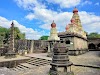

Great Shiva Temple excellent place
Nice place,
👏👏👏
Ajinkyatara in Satara should walk along the palace as he enters the castle. On the right side of the palace, the temple of Mahadeva will be built. This temple belongs to Shri Ratneshwar Mahadev. A great place to take shelter but with no roof, you have to sit in the open space. Due to the renovation and renovation of the temple, the temple is now looking more beautiful. Just beware of the spiders.
Legendary Mahadev Temple on Ajinkyatara Fort. We should take care of this structure ...... RMSV
This is a very old Ratneshwar Mahadev Temple.
Ajinkyatara is erected on the Bamnoli line erupting from Pratapgad. The height of the Ajinkyatriya is generally 2 meters and its southward extension is 2 meters. Today, many social activities like tree plantation are implemented at this fort.How to go?[[Image: Sajjangad and Ajinkyatara road.jpg | thumb | left | Map]] Ajinkyatara Fort is in the city of Satara and many walks pass through the city. From Satara ST, any vehicle passing through the court fence can reach the court fence and reach the fort. Bus service from Satara to Rajwada is available every 2-3 minutes. It takes about 5 minutes walk from the Rajwada bus station to the court yard. The road leading to the courthouse starts on the road leading to the fort. And that road is 5 km. As they walk, the man reaches the gate of the fort. There is also a direct train road to Ajinkyatara castle. It takes about 4 hours to reach the fort by any means. Early morning climb is good for natureEdit HistorySataras fort (Ajinkyatara) is the fourth capital of the Marathas. First Rajgad then Raigad followed by Jinji and 4th Ajinkyatara. Sataras fort was built by another Bhojraj of the Shilahar clan. Built in 1959. Later this fort went to Bahamanisat and then to Adilshah of Bijapur. In 8 CE, the wife of the first Adilshah was imprisoned at Chandbibi. As Shivajis kingdom was expanding, this fort came into the hands of Shivaji Maharaj on 7 July. On this fort, Shivarai had to rest for two months after suffering from fever. After the death of Shivaji Maharaj, Aurangzeb entered Maharashtra in 5. C. In 29, Aurangzeb besieged the fort of Satara. At that time, Prayagji was the fortress of the fort. On the morning of April 2, the Mughals excavated two wells for the tunnel and within a moment, the tower of Manglai was thrown into the sky. Another explosion occurred just after some Marathas were hit by the coast. A large coast collapsed on the advancing Mughals, and a half thousand Mughal troops were killed. All the ammunition and ammunition on the fort was over and on April 7, the fort was won by Subhanji. It took about four and a half months to hit the Mogli target on the fort. The castle was renamed Azmatara .The star army again won the fort and renamed it Ajinkatara, but again the fort became subject to the Mughals. However, in 7, Shahu slipped and took the fort and anointed himself as king. Shahu founded Satara city at the time of taking charge of the Marathi Empire. After the death of the second Shahu, the fort went to the British on 7 February.Edit places to see on the fortThere are two gates on the way from Satara to the entrance to the fort. Even today the first of these two doors is still in good condition. Both door bases exist today. As you enter through the door, on the right is the temple of Hanuman. This temple is a great place to stay. But there is no water supply on the fort. After passing the straight road on the left, the temple of Mahadeva falls on the road. In front there are two offices of Prasar Bharati Kendra and two towers in Prasar Bharati Kendra. Going forward, one looks to the left and it says Mangla Devi Temple. Across the street is Tarabais residence but now the ruined palace and the barn. At the end of the path is the temple of Mangala Devi. In front of the temple is the tower of Mangalai. Many sculptures are found in the temple premises. Going straight along the embankment along this route is like parading a fort. There are also two gates to the north of the fort. They catch sight of the beaches. The path leading to this door comes from Satara-Karad Hamastar. There are three pools of water at the door. There is no water in summer. The fort has to bend down and down the road. From the fort, the Yavateshwar plateau, Chandanavandan fort, Kalyangad, Jaranda and Sajjangad are visible from the front.Also on the south side is the village of Nnam (Pangali). This village is the shrine of Kolhapur (Ratnagiriwangi) Jotiba, in an ancient (7th century). It is also a village. There is an ancient site called Pandavagal and there is a lake to the west of this village.It takes about an hour and a half to see the entire fort.
It is good
- Address:Satara, Maharashtra 415002, India
- Hindu temple
- Monday:Open 24 hours
- Tuesday:Open 24 hours
- Wednesday:Open 24 hours
- Thursday:Open 24 hours
- Friday:Open 24 hours
- Saturday:Open 24 hours
- Sunday:Open 24 hours
Similar organizations
- Tuljabhavani MandirSatara, Khindwadi, MIDC, Satara, Maharashtra 415004, India
- Shri Samarth Navgrah Mandir402, Mangalwar Peth, Guruwar Peth, Satara, Maharashtra 415002, India
- Shree Janai Malai Devi MandirGanesh Nagar, Godoli, Satara, Maharashtra 415002, India
- Ganesh Jotiba Mandir KodoliKodoli, Satara, Maharashtra 415004, India
- Panchamukhi ganesha temple605, Khalcha Rasta, Budhwar Peth, Shaniwar Peth, Malhar Peth, Satara, Maharashtra 415002, India
- HaHanuman Mandir Ashramshala KharadewadiSatara, Maharashtra 415528, India
- श्री राम मंदिर संगम माहुलीSangam Mahuli, Satara, Maharashtra 415003, India
- Shri Rameshwar MandirUnnamed Road, Kshetra Mahuli, Satara, Maharashtra 415003, India
- MaMayakka TempleSatara, Maharashtra 415114, India
- Ganbaba MandirSatara, Maharashtra 415528, India