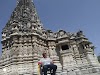
The Chaturmukha Jain Temple of Ranakpur In the heart of the remote and enchanting valley of the Arvallis, skirting the rivulet Maghai and enveloped in the solitude of the surrounding forest, stands, in solemn grandeur, the Chaturmukha Jain Temple of Rishabhadeva. Placed on a lofty plinth, the three-storeyed marble edifice, to which the genius of the artist has imparted exquisite artistic grace, and which his deep devotion has endowed with serene spiritual dignity is, verily, a poem in stone. Majestic yet in complete harmony with Mother Nature, in whose beautiful lap it rests, this magnificent monument of devotional architecture seems bathed in celestial bliss. The very hills around, dwarfed by its imposing bearing, appear absorbed in mute meditation, as if spell-bound. The concord achieved between the bounteous generosity of Nature and mans creative expression of gratitude, stands uniquely symbolised in this Divine Creation. To behold this holy shrine in its spectacularly sublime settingis to experience instant uplifting of the soul.Rajasthan is famous for its rich and prolific art treasures. Some of its architectural monuments are considered among the best in the world. The Ranakpur Jain Temple excels them all as an exquisite work of art and architecture. There are a number of beautiful and delicately carved sculptures in this shrine which defy comparison. The temple is an eloquent testimony to Indias cultural heritage, her unique architecture and the vision and acumen of her past master artists.This temple is the realiation of the vision and endeavours of four great and devout seekers They were Acharya Somasundatsuri Dharanashah, the Minister to Kumbha Rana, Rana Kumbha himself, and above all, Depa or Depaa, the architect who made the realisation of the dream possible.Acharya Somasundarsuriji was a magnetic personality who lived in the fifteenth century of Vikram Era. Shreshti Dharanashah belonged to the village Nadia near Ranaipu From here he had migrated to Malgadh. His fathers name was Kurpal and Kamalde was his mother. He had an elder brother named Ratanashah. They had descended from the illustrious portual clan. Dharanashnh came into contact with Acharya somasundarsumi who infused a strong spiritual urge in his heart. At the age of thirty-two, when he visited Shatrunjaya, the foremost among all the places of Jain pilgrimage, Dharanashah tonk the austere vow of lifelong celebacy. Aided by his sharp intellect, a keen administrative power and an innate capacity to lead and govern, he had risen to the position of a Porwal Kumbha Rana. one blessed moment Dharanahah felt the spontaneous urge to build a temple of Lord Risabihadeva, which he resolved, should be without parallel in beauty. A legend tells us that one night in his dream. Dharanashah had a vision of Nalinigulma Viman which is considered to be the most beautiful among the celetal planes. Dharanashah decided that the temple should resemble this heavenly VimanHe invited many renowned artists and sculptors They submited their plans and designs, but none could even remotely capture the Ministers dream image. last an easy-going sculptor named Depak from Mundara presented a plan, which simply thrilled the heart of Dharanashah. He was profoundly impressed. Depak was a carefree type of an artist and would prefer poverty to servility. He set very high value on his art. He was deeply touched by the transparent personality and devoutness of Dhararashah. He promised to create a temple which would give concrete shape to the Ministers dream. And thus, a rare confluence of art and devotion was effected by the two visionarie. Dharanashah approached Rana Kumbha with a request to give some land for the construction of the temple. The king not only gave the land but advised Dharanashah to build a township also near the site. The site of the old village Madgi in the valley of Mount Madri was selected for the purpose. The construction of the temple and the township began simultaneously. The town was named Rampur after the name of King Kumbha Rana. Ranpur is popularly known
Very old & best temple.
A must visit place. Religious and historical place.
Must see
Ranakpur Adinatha Jain Temple located in Pali (Rajasthan) 90 KM away from Udaipur.Constructed in 1437-1458.👌Over 1444 marble pillars, carved in exquisite detail, support the temple. The pillars are all differently carved and no two pillars are the same. It is also said that it is impossible to count the pillars. Also all thestatues face one or the other statue. There is one beautiful carving made out of a single marble rock where there 108 heads of snakes and numerous tails. One cannot find the end of the tails. The image faces all four cardinal directions. In the axis of the main entrance, on the western side, is the largest image.
Awesome place. If you visit Ranakpur must go to jain temple. Our hotel manager of Ideal Lake View Resort suggested this. Their is surya narayan temple near it as well
Its called as The Chaturmukha Jain Temple as it has four artistic entrances and its around 100 KM from Udaipur. You can book a cab from Udaipur to reach here. Please visit this place as its a amazing piece of 3D rock art.You can spend hours watching and admiring this beauty of temple.There are about 1444 pillars in the temple.
This temple is a reminder of India’s rich cultural heritage. The Jain Temple in Ranakpur has more than 1,400 pillars and a huge bell that weighs 238 pounds (108 kgs).
It is a marvelous quite and calm place full of a unique kind of spirituality where one has to believe in super powers as it is almost impossible to build such a place even with modern engineering and equipments.
Really awesome place to visit today & unlimited art...
Really awesome place to visit , ultimate art of 14th century. A must visit for Rajasthan tourist.
Magnificent sight. A must see.
Out of the imagination carving Must visit place
Not good change & make good sow. Vary poovar.
Brilliant and nice temple
Jain temple, Darshan, at Ranakpur
Popular jain temple..
This is the main temple in the complex. Also 2 other temples are present in the complex and one outside the complex.
Best place to visit
Nic place
Nice
Must visit place
Good
Good
Mast he
Bhut acha temple hIt does not work in any way
Ranakpur is a Chaturmukhi Jain temple of Lord Rishabhdev surrounded by forests around the valleys of Aravalli mountain in Rajasthan. Being surrounded by forests, the grandeur of this temple is seen on sight. It is probably the grandest and largest building among the Jain temples of India. Ranakpur temple is at a distance of 96 km from Udaipur.The building of this temple is spread over 40,000 square feet. About 600 years ago, the construction work of this temple started in 1446 Vikram Samvat, which lasted for more than 50 years. It is said that at that time about 99 lakh rupees were spent in its construction.This temple has 4 artistic entrances. The main house of the temple has 4 huge marble statues of Tirthankara Adinath made of marble. About 72 inches high these mites are oriented towards 4 different directions. That is why it is called Chaturmukh Temple.Apart from this, there are 76 small dome sanctum, 4 big prayer halls and 4 big worship places in the temple. They inspire man to attain salvation by attaining liberation from the 84 yonas of life and death.4The main feature of this temple is its hundreds of pillars numbering about 1,444. Whichever side you look here, you see pillars of big and small sizes, but these pillars are designed in such a way that darshan of the main holy site is not obstructed from anywhere. These pillars are beautifully carved. The special feature of these pillars is that they are all made of unique and different artifacts. The carving on the roof of the temple symbolizes its excellence.While the makers of the temple have constructed an artistic double storeyed building, many cellars have also been built anticipating a crisis in the future. Sacred idols can be preserved in these cellars. These cellars demonstrate the construction foresight of the temples builders.In 1953 Vikram Samvat, the responsibility of the maintenance of this temple was given to a trust. He gave it a new look by efficiently renovating the temple. The carving on the stones is so grand that many famous craftsmen call it one of the wonders of the world. Thousands of art lovers visit this temple every year. Apart from this, there is also the footprint of Lord Rishabhdev on the marble piece. These remind us of the teachings of Lord Rishabhdev and Shatrunjaya.How Ranakpur was built - This temple was built by 4 devotees - Acharya Shyamsunderji, Dharan Shah, Kumbha Rana and Depa. Acharya Somasundara was a religious leader while Kumbha Rana was the king of Malgarh and Dharan Shah his minister. Dharan Shah, inspired by religious trends, had decided to build a temple of Lord Rishabhdev.It is said that one night he saw Nalinigulma Vimana in his dream, which is considered to be the most beautiful among the sacred planes. On the lines of this aircraft, Dharan Shah decided to build the temple. Dharan Shah invited many architects to build the temple. He did not like any of the schemes presented by him. He was eventually satisfied with the plans of Deepak, a simple architect from Mundara.Malgarh King Kumbha Rana gave land to Dharan Shah for the construction of the temple. He also suggested to establish a city near the temple. A village called Madgi near the temple was chosen for this and construction of the temple and city started simultaneously. It was called Ranpur after the name of King Kumbha Rana, which later became famous as Ranakpur. Todays Ranakpur also gives a message about the old heritage and the people who saved it, due to which Ranakpur was able to change from a mere idea to reality.Anyway, Rajasthan is famous for its magnificent monuments and buildings. Ranakpur temple located in Rajasthan is one of the 5 major pilgrimage centers of Jainism. This temple is famous for beautifully carved ancient Jain temples. Around the temple complex are 2 temples dedicated to Neminath and Parshvanath, which remind us of Khajuraho. Pictures of warriors and horses are engraved on the walls of the Sun Temple built here, which in itself is a classic example. There is also a temple of Mata Amba about 1 kilometer from here.Sincerely, veb world
Impressive 100% white marble construction. Inside it is full of hundreds of unique columns with impressive details. It has a lot of history, so it is highly recommended to visit the audio guide, available in Spanish. The entrance costs about 200 rupees plus the extra of a camera. One of the best temples in India in a fairly remote corner.
Ten kilometers south-east of Sadi in Pali district of Rajasthan, the magnificent temple of Ranakpur, situated in the picturesque lap of the Aravalli ranges, covered by natural sushma on the banks of the Maghai River, is a visible and unique chaumukha temple of medieval craftsmanship. This three-storey temple built in about fifty thousand square feet is dedicated to the first Jain Tirthankara Sri Rishabhdev (Adinath). The construction of this temple was started during the reign of Maharana Kumbha of Mewar with the inspiration of Acharya Somasundarsuriji, and Porwal Jains named Ratnashah by laying the foundation of the temple in Samvat 1733. In connection with the construction of the Ranakpur temple, it is said that Dharnashah had a dream in one night, when he saw a devil like Nalinigulam, he got a feeling that a temple of this type should be built. In order to fulfill his resolve, Dharanshah asked many craftsmen to map, but did not make a map of any artisan according to his dream, in the end, a sculptor named Mundara resident Deepa outlined Seths dream and seeing this, Dharanshah gave the work of temple construction to Deepa. handed over. The Dharanshah was a ministerial position near the Maharana of Mewar in those days, and he demanded land from the Maharana. While offering the land for the temple, Maharana suggested to build a temple in the foothills of the Madri mountain range and also establish a river. Minister Dharanshah started the construction of the temple there and also settled the city, which was named Ranpur, which later became famous as Ranakpur. While laying the foundation stone of the temple, Shilpi Deepa also tested the spirit and generosity of the Dharanshahka by laying seven types of metals, Kasturi and many valuable things in the foundation. In its construction, under the direction of Principal Shilpi Deepa, hundreds of well-trained artisans, after continuous labor for 45 years, gave a beautiful shape to the silent stone with their chisel and hammer and instilled it with the rashadra of devotion. Dharanshah spent 90 lakh gold currency on its construction. When the construction work was completed, fifty years had passed, yet the work of the temple was not completed, in view of old age, the superior Dharanshah decided to make his Jeetji temple prestige and according to the main inscription of the temple. In 1797, the work of prestige was completed under the leadership of Acharya Somsundrasuriji. It is said that in the last watches of Dharanshah, his brother Ratnashah promised to complete the construction of the temple according to his wish. And for ten years, keeping the work of the temple in progress, completed the work of incomplete pavilions. This grand three-storey temple resting on 14 pillars is an excellent specimen of architecture and sculpture. It has 24 pavilions and 58 devakulikas. It is also known as Chaumukha Temple due to the four gates having uniformity in all four directions. On entering through each gate, the sabhamandap and the Meghnad pavilion symbolize equality on all sides. The tall pillars with long archways and their long rows look very attractive. The western gate remains open to enter this chaumukhe temple, after walking beyond the Shringar chowki, the sabhamandapa and the Meghnad mandapa, whose artistic roof and dome exist in their own specialty. It is a wonderful experience to see the panoramic statue of the original Lord Rishabhdev installed in the four directions of the original temple - as if you have achieved everything today. The design of all the pillars of the temple is decorated with balloons but all are different from each other. As a symbol of the craftsmanship of the craftsmen, the Kalpavriksha leaf on a roof and the ornamental texture of Sahastranag as well as the carving of the statue of Lord Parshvanatha covered with the parasol of Dharmendra Nag-Nagis have been wonderfully carved. The hanging stone chandeliers in the meghampandapa and fenestra and the flower petals engraved in them are also attractive. The circumambulation of the temple enchants the viewer due to the statues of various gods and goddesses with fine expressions, in which there is a beautiful uncle of Saraswati, Vishnu, Daksha including beasts and bellboots. All the expressions of women described in medieval poetry have been inscribed here with crafts. Adorned, adorned ornaments in the frontier, removing prickly thorns in the delicate feet, and tying the anklets of the feet, niggles in the game with the infant, absorbed in music, etc. In the entrance of the temple, a pillar in the first Meghnad pavilion has small figures of Seth Dharanshah and Shilpi Deepa. Similarly, the inscription inscribed on the pillar of another assembly pavilion confirms the arrival of Mughal emperor Akbar here.
A Buitifull Paste ...
- Address:Ranakpur, Rajasthan 306702, India
- Jain temple
- Tourist attraction
Similar organizations
- Sun Temple LohargalRJ SH 32, Ranakpur, Rajasthan 306702, India
- Jain old TempleRanakpur, Rajasthan 306702, India
- Ranakpur Hill ResortRanakpur Road, Sadri PO, Pali District, Ranakpur, Rajasthan 306702, India
- Maharani Bagh Orchard RetreatRanakpur, Rajasthan 306702, India