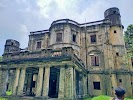

A relic with a history forgotten, this old house has the potential to draw a lot of bucks for the botanical garden. Had it been in some other country, they would have restored it, glammed it up, made it into a museum and started spinning money. The botanical garden needs an Ecopark-like facelift swanky enough for the trendy youngsters to hangout. And this old gem can be one of the stars in the revamped park. The view from that sitting area overlooking the river will give a priceless memory for sure. I hope someone gives Didi the idea or shows her the prospects, and she will definitely do something good to it. For the art lover she is, she can surely make it a happening place.
Off the beaten track in the Zoological Gardens. You are probably not officially allowed to visit this beautiful, historic and overlooked building. Unfortunately the authorities show no interest in its upkeep and it is gently crumbing before your eyes. I have visited several times now and although it is not a tourist attraction, it has a magical quality and I am compelled to return and soak up the atmosphere on each of my visits to the Botanical Gardens. To my mind it is as important as any of the major tourist honey pots, yet locally nobody appears to value it. Be careful if exploring and avoid the main stairs which are now too dangerous to climb. (Use the servants staircase which is made of stone).
The place is within botanical garden premises. Unfortunately you cannot visit this place as it is fenced. I tried to visit the area but the security guards didnt allow. However I was very disappointed seeing that there is no maintenance for this house.
NIL Maintenance and waiting for its slow death. This building was built by the first Curator of B Garden in approx 1794-95. But today it lays in ruin. It could have been a very good museum if preserved properly.
Amazing place. It needs to be taken care of.
The place was first built on 1632 as a fort at the time of mughal king Shah Jahan to restrict the Portuguese pirates. opposite side of Ganga was Meriaburj fort ( matir kella), after 150 years British constructed a new building.
Nice old place
I saw roxburgh da having 12 feet of shikni with bik nun....... aapni ki dekhechhen?
The dilapidated Roxburgh Building and the herbarium (storehouse of dried plant), that boasted one of the richest collection of plant specimens anywhere, and the library in front of it in a restricted area of the Indian Botanic Garden in Shibpur, which went to ruin after they were abandoned in the 1970s, but unless urgent measures are taken to restore both the heritage buildings will fall to pieces.The sprawling garden on the banks of the Hoogly opposite Metiabruz was founded by Colonel Robert Kid in 1787, and William Roxburgh was its first salaried superintendent between 1793-1884. The building named after him was constructed around1794, and although initially it served as Roxburgh’s residence, he subsequently constructed a plant house and the library in the dilapidated house opposite it. Roxburgh was a pioneer in botanical studies in India and he has written “Flora Indica”, once the bible for botanists studying Indian flora.Little is known about the early life of Robert Kyd. He was born at Forfarshire may have studied medicine at Edinburgh. He joined the Bengal Engineers as an ensign in 1764. He become a lieutenant a year later, a captain on 3rd April,1768 major on 29th May,1780, and lieutenant-colonel by 7th December ,1782.He was then made a Secretary to the Military Department of inspection in Bengal and continued in that post until his death.Kyd was interested in horticulture and owned a private garden in Shalimer near howrah. He proposed the idea of a botanic garden to the then Governor General Sir John Macpherson, who passed on the idea to the Court of Directors of the East India Company. His idea was that it should help in finding alternate sources of food to prevent famines and to identify plants that might be commercially useful. The plan was approved on 31st July 1787 and Kyd was made an honorary Superintendent. Kyd made a request in his will that he be buried without any religious ceremony in the botanical garden that he founded, but was instead in South Park Street Cemetry.Much development in Botany took place during British Empire in India. Linnean system of “Binomial nomenclature” was introduced only in 1778 by the natural historian engaged with the British East India Company. During this period, botanical gardens were being founded in every significant city in India to study the natural history of plants. Many botanists and surveyors were recruited by East India Company to report and record Indian flora. One such botanist of this period and the founding father of Indian botany by his contemporaries was William Roxburgh.William Roxburgh was born on June 29th 1751. He matriculated at Edinburgh University in 1771-72 to study surgery under Dr. Alexender Monro. Further he was also the student of Dr. John Hope, professor of botany and “Materia-medica” .John Hope was the curator of the Edinburgh botanical garden as well an experimental physiologist. Roxburgh reached Chennai in 1776 as an assistant surgeon in the East India Company’s Madras General Hospital. At Chennai he turned his attention to botany. For the period 1776-1793 he worked at Coromandel Coast, during this period he also met Johann Gerhard Konig (who introduced binomial nomenclature in India). In 1789 he was appointed as natural historian of East India Company.He moved to Kolkata to be the superintendent of the Boanic Garden, the present Indian Botanical Garden at Shibpur, Howrah. He was instrumental in introducing many plant and species to India and simultaneously he sent many species to Kew, London. His voluminous work, “Flora Indica” was published after his death. Roxburgh left for England from Kolkata in 1813 at the age of 62 spending some 37 years in India. He died at Edinburgh in 1815.Dr. William Roxburgh was a botanist who made immense contribution to the study of Indian botany and is regarded as manyas the father of Indian botany. He was also interested in meteorological impacts on droughts and famine, and therefore, recommended for food tree plantation in the countryside and in public land.
My and my familys old and lovely ❤️ memories
Abandoned
Good place
Place where roxburg lived
Great place
Beautiful
Sim
- Address:4, Botanical Garden Rd, Indian Institute of Engineering Science and Technology, Shalimar, Howrah, West Bengal 711103, India
- Tourist attraction
- Good for kids:Yes
Similar organizations
- Manishalaya( Museum Of Statues)7/3/2, Guru Nanak Rd, B Shalimar Area, Shalimar, Howrah, West Bengal 711103, India
- Adwitiya Saree MuseumSapuipara, Ghosh Para, Howrah, West Bengal 711227, India
- BiBiond PurBura Bazar, Bankra, Howrah, West Bengal 711409, India
- ktktc dal milMumbai - Kolkata Hwy, Naora, Shibpur, Howrah, West Bengal 711102, India
- Old Rail EngineR B C Rd, Howrah Railway Station, Howrah, West Bengal 711101, India
- LaLadies Tailor & Blouse Museumopp. Thana, Fokor Dokan, Baruipara, Domjur, Howrah, West Bengal 711405, India
- MoMother Terasa Statue BelgachiaF Rd, Belgachia, Liluah, Howrah, West Bengal 711108, India
- Everest Base Camp Museum2, 3, Baruipara, Ichapur, Howrah, West Bengal 711104, India
- The stone tablet gallery15/6, Swarnmayee Rd, B Shalimar Area, Indian Institute of Engineering Science and Technology, Shalimar, Howrah, West Bengal 711103, India
- Khan HousePadmapukur Water Treatment Plant Rd, Padmapukur, Shibpur, Howrah, West Bengal 711109, India


